
How I Use AI to Reduce Neurodivergent Workday Friction
AI is often talked about as a productivity tool. And yes, it can be that. It can help draft faster, summarize faster, organize faster, and move work along with less manual effort.
But as a neurodivergent person, AI is also an access tool.
It helps reduce the friction between what I understand to be true, what I’ve confirmed to be true, what I mean, what I can access in the moment, and what a corporate environment expects me to produce. It helps me translate, organize, clarify, prepare, and sometimes simply begin.
I may create a separate page of simple AI prompts for neurodivergent folk in the future, but for now, I wanted to share more about the kinds of work friction AI can assist with.
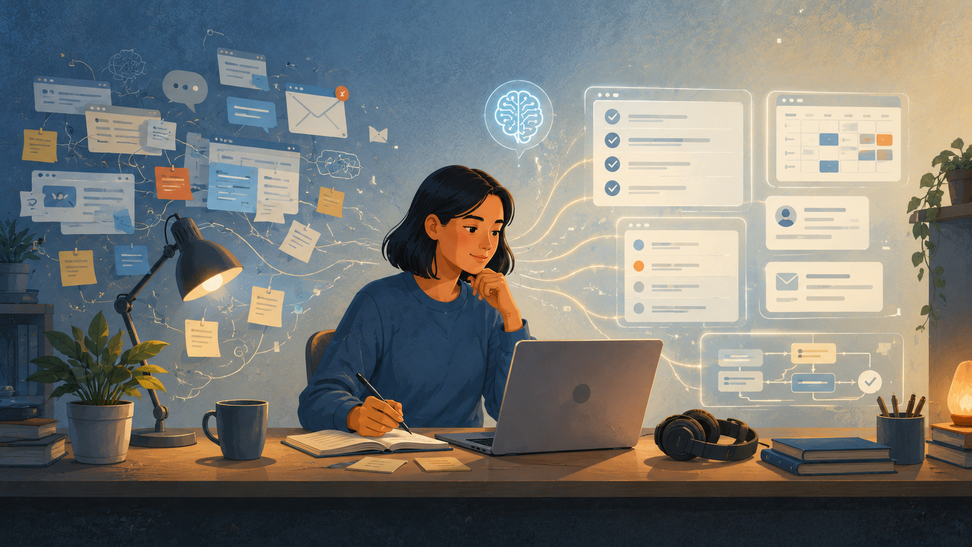
When starting is harder than doing
This happens more often than I'd like to admit: I know exactly what needs to happen yet still cannot seem to initiate things. I can recognize patterns and spot an outlier like no one else, but I don’t process things in a linear or chronological way. This can make both taking in information and communicating it back out extremely difficult, not to mention taxing.
If you're neurodivergent like me, you know we aren't lacking willpower. Sometimes the task is too vague, too big, too emotionally loaded, or surrounded by too many competing inputs. AI can help us lower the activation energy.
Instead of trying to “finish the project,” “write the email,” or “figure out the plan,” I can ask AI for the smallest possible first step, a 10-minute starter task, or help making a messy first draft.
Honestly, starting smaller is what makes starting possible.
When my thoughts are real but not linear
I have too many thoughts, and they’re everywhere!
I might have the insight, the context, the pattern, the concern, and the point I am trying to make — but never in a clean sequence yet. Corporate work rewards linear communication, and my brain does not always produce things in that order on the first (or second) try. It can be really embarrassing when you know how smart you are, how many complex thoughts you have in your brain, but all you can procure in a meeting is what appears to be an absent mind.
This is where AI is incredibly useful.
I can paste in messy notes, a transcript, a voice memo, or a chaotic paragraph and ask it to pull out the themes, organize the ideas, find the throughline, or turn the mess into something easier to work with.
That does not mean AI is creating the thought for me. It is helping me structure what is already there.
When communication requires translation
Corporate communication is full of hidden rules. Beginning when I was a kid, I’ve had to closely observe other people’s tone, phrasing, and even facial expressions so I can figure out what is expected in similar situations. When I began working in Corporate, and realizing there was an entire additional layer of communication to decode, and then trying to follow it, felt exhausting. Sometimes it also feels political in a way that borders on slimy.
Be clear, but not too blunt. Warm, but not too casual. Direct, but not harsh. Confident, but not defensive. Brief, but never missing context.
For someone who is naturally direct and does not instinctively read between the lines, following those social rules takes a lot of energy.
AI helps me translate without disappearing. I am not trying to sound like a different person. I am trying to make sure what I mean has a better chance of being understood.
That might mean asking AI to make a message clearer and more tactful, soften the tone without losing directness, or rewrite something so it sounds human, warm, and clear.
The goal is not to become more corporate, but to reduce misunderstanding.
When vague expectations create invisible labor
A lot of workplace friction comes from ambiguity.
A request like “Can you take a look at this?” can mean review it, fix it, summarize it, own it, escalate it, or quietly make the problem disappear. A vague project can also hide unclear ownership, missing deadlines, unstated definitions of success, and a long list of assumptions no one has said out loud.
For neurodivergent people, this can create a huge amount of invisible labor. I often want historical context in order to understand what is happening now and what needs to happen next. I also tend to think carefully about downstream impact. How will this decision ripple out? What else will it affect? The level of complexity I naturally account for often goes beyond what other colleagues are considering.
AI helps me slow the request down. I can ask what is actually being asked, what clarifying questions would help, what “done” might look like, or how to turn the assignment into a checklist.
Yes, this is incredibly helpful for organization, but more importantly, it makes hidden expectations visible enough to respond to. That means less wasted effort, less unnecessary overwork, and fewer spirals into the thousand possible paths the task could take.
When meetings create more inputs than clarity
Meetings can be useful, but they can also create a mess of scattered information.
There are decisions in one place, action items in another, context buried in a side comment, and follow-up happening later in Slack. Sometimes I leave a meeting technically informed but still unclear on what actually changed or what I personally own.
AI can help pull the useful pieces back together.
I can ask it to summarize a meeting transcript into decisions, action items, and open questions. I can ask what I committed to, what needs follow-up, or how to turn meeting notes into a clear message. Use multiple AI tools to see what consistently provides the best output for you. You’d be surprised by the difference between models.
I keep my meeting summaries in a Google doc as well. At the end of the quarter or year, it helps me review the things that were asked of me, the things I reported working on, and catches the forgotten little things when it comes to performance evaluation time.
This is especially helpful in roles where work moves across people, projects, systems, and shifting priorities.
When there is too much information to sort through
For project managers, analysts, support teams, people partners, and operations professionals, the problem is often not a lack of information. It is too much information spread across too many places.
AI can help identify patterns, summarize customer or employee issues, turn data into plain-language takeaways, and surface what information is missing before something is escalated.
This is one of the clearest ways AI can support both accessibility and quality. It reduces the cognitive load of sorting through everything manually while also helping the final output become clearer, more accurate, and more useful to other people.
I saw this firsthand when my team was making assumptions about workload across 15 entities based mostly on personal observation. That concerned me, especially because of the bias. I had access to the full stream of incoming email requests for the team, along with the skills to clean, sort, and analyze the data. What I did not have was much time. Leadership was close to making decisions that could have a major impact on the team, and I needed to pull together insights quickly.
AI helped me move faster and check my thinking as I worked. The result was a set of evidence-based insights that challenged the team’s assumptions and gave leadership a clearer picture before decisions were made.
When rejection sensitivity creeps in
Some of the most useful AI prompts are about nervous system support.
After a confusing message, tense meeting, unclear interaction, or long day of context switching, I can get stuck replaying things. What did they mean by that? Did I miss something? Was I too direct? Do I need to respond now? Am I making this bigger than it is? Am I not treating this urgently enough?
AI can help me separate what happened from what I am assuming. It can give me multiple possible interpretations of a situation, help me find the most neutral read of a message, or create an end-of-day shutdown list so every open loop does not follow me home.
I want to point out, this does not replace judgment, rest, boundaries, or actual workplace support. It does help prevent spiraling.
AI is not the solution to inaccessible workplaces
AI should not have to compensate for workplaces that rely on vague expectations, hidden rules, poor communication, constant urgency, or one-size-fits-all ways of working.
But in the world many of us are working in right now, AI can be a useful form of scaffolding.
For me, the value is not just in doing more. It is in reducing the friction between my brain and the environment around me.
It helps me begin, structure, translate, clarify, summarize, and reset.
Long before AI, neurodivergent folk have used other tools. Are you using AI to help with your neuro-spicy mind? If so, how? I'd love to hear about it.