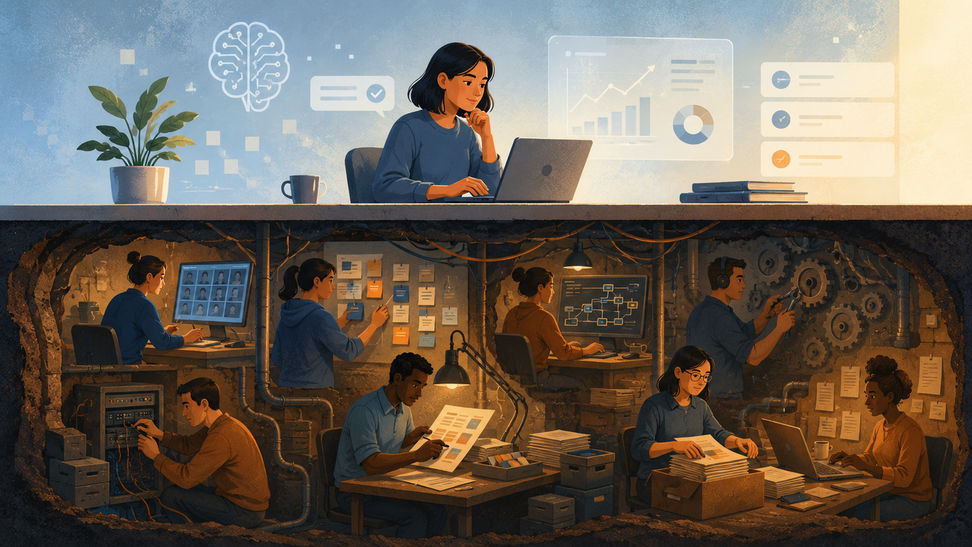
One of the biggest myths about AI at work is that efficiency gains show up as clean, usable free time.
A task gets faster. A template gets created. A workflow gets streamlined. A process gets partially automated. Leadership sees this and assumes the result is obvious: now there is more room to take on additional work.
But that is not the whole picture.
AI does not just reduce labor. It also creates labor.
Someone has to maintain the prompts. Someone has to update the templates. Someone has to monitor whether an automation is still working the way it was supposed to. Someone has to catch edge cases, troubleshoot failures, revisit assumptions, and deal with what happens when workflows drift under real-world pressure.
That work is still work.
It takes time, attention, judgment, and context. And in many organizations, it gets added quietly, without any real reduction in the responsibilities that were already there.
I saw this firsthand in a corporate environment. I was told to build efficiency in order to reduce my workload by 20% so I could take on more. The problem was that the people making that demand did not actually understand what I was doing to begin with. They did not know what percentage of my workload the current work was taking up. They did not know what it would really look like to make that work more efficient. And they definitely did not understand how much time it would take to even research the scope of meaningful process changes.
My day already had no downtime. I often did not have time for lunch. I regularly worked late. Even small project legwork required time I did not actually have unless I gave up more of my own capacity. All of this while being told that taking on more would make me more promo ready. I was already operating beyond and above my pay grade. And the company itself had changed dramatically. My predecessors had done a version of the role when the company was much smaller. By the time I was doing it, the company had doubled in size. The workload, complexity, and expectations had all expanded, but that reality kept getting flattened into a much simpler story: find efficiencies, use AI, free up time.
It did not matter how often I said I was burned out. The assumption stayed the same.
I saw the same pattern in consulting work too, even outside a corporate environment. Prompts and templates needed upkeep. Workflows drifted because the team did not have enough capacity to maintain consistency. Edge cases emerged, but there was no time to research what happened, understand the root cause, or build prevention into the process. Governance and quality control got reduced to emergency situations only.
And underneath all of that was a deeper truth: the owner was so disconnected from the team’s day-to-day reality that they did not realize the business needed a full-time person just to get to a baseline level of stability where meaningful efficiency work could even begin, with or without automation.
That is the hidden labor of AI efficiency.
It is not just the visible output. It's the ongoing burden of monitoring, adjusting, the exception handling (it's always the exceptions that get us, right?!). It is the decision-making that has to happen when the system does not behave the way leadership imagined it would. I don't know about you, but no matter how detailed or complex a prompt I give a GPT, I still need to carefully review its output, and sometimes after all of that, I still don't get an answer that I can use even a part of.
And it is also the way the role itself changes.
When AI or automation changes how work gets done, the role changes too. But leadership often skips over that entirely. They treat the shift as if it simply removed work rather than transforming it. Suddenly someone is not just doing their original job. They are also maintaining prompts, checking outputs, managing process exceptions, documenting changes, monitoring for quality issues, and keeping things from quietly breaking over time.
I'm finding this redesign happens without acknowledgment, support, compensation, or even clear expectations. Before you know it, confusion and ambiguity creeps in. People can get stuck between what they were hired to do and what they are now implicitly responsible for.
This is where a lot of leadership thinking around AI starts to break down.
Leadership simply wants to know the efficiency, measured only in terms of time saved. But, are they interested in terms of labor shifts, maintenance created, or cognitive load redistribution? The more removed a leader is from the work itself, the easier it is to imagine that automation simply cleared space. But on the ground, what often happened was that the work actually changed and is even harder to see.
That is why leadership has to get more curious, not less.
Before claiming efficiency gains, leaders should be working to clearly understand:
- What labor did this actually remove?
- What new labor did it create?
- Who is responsible for maintaining it?
- What happens when it fails, drifts, or produces a bad output?
- Has this role changed enough that workload, scope, or compensation should be revisited?
Those are the kinds of questions that separate thoughtful change from magical thinking. Additionally, it allows a great leader to be in a position to best advocate for their teams.
AI can absolutely help people work more effectively. But unless leaders account for the hidden labor it creates, those gains will keep being overstated, and the people closest to the work will keep carrying the difference.
In other words, AI does not just create efficiencies. It creates new responsibilities, new maintenance burdens, and new forms of invisible labor. If leaders want to benefit from that shift, they need to be honest about what it costs.
Otherwise, “efficiency” is just another word for asking already-stretched people to absorb even more.
If this pattern feels familiar, I put together a free AI Pressure Checklist to help identify when “build efficiencies” is really masking a capacity problem.